

Animal Welfare
At Taco Bell, you can crave without compromise knowing that we hold our suppliers to high standards. Guided by Yum! Brands’ Sustainable Animal Protein Principles, we take a holistic, science-based approach to continuous improvement in sustainable food production systems that protect human, animal, and environmental health.
Beef
One great opportunity to leave a lasting impact on the world around us is to reduce the amount of greenhouse gas emissions in our food supply chain, particularly in our animal proteins. Our membership with the U.S. Roundtable for Sustainable Beef (USRSB) and the partnerships we’ve developed with Cargill allow us to implement things like conservation and regenerative agriculture practices across cattle grazing lands.
We’re also working to reduce antibiotics important to human health in our U.S. and Canada beef supply chain. With these initiatives, we are taking bigger steps to improve the environmental effects of our supply chain.
Chicken
We are proud to serve chicken raised without antibiotics important to human medicine in all U.S. restaurants, from suppliers certified by the USDA Process Verified Program. This includes our grilled, marinated, all-white meat chicken as well as our new slow-roasted chicken in the Cantina Chicken Menu.
Eggs
We serve 100% cage-free egg ingredients across our entire menu, including limited time offerings. The Breakfast Crunchwrap you got this morning? Cage-free breakfast eggs. The Spicy Ranch Sauce in your Cheesy Gordita Crunch? Made with cage-free eggs. The Cinnabon Delights? You guessed it – made with cage-free eggs. *Cue mic drop”.
Packaging & waste
We believe in satisfying every craving—not creating excessive waste. That’s why we are taking a holistic approach when it comes to packaging and waste reduction. We are working to eliminate unnecessary packaging, shifting materials of existing packaging where needed, and working to support better recovery & recycling systems. So everyone can enjoy tacos for a very long time.
SAUCE CONTAINER RECYCLING
We accept and recycle all brands of empty sauce packets, dipping cups, soufflé cups with lids, and coffee creamer pods via our TerraCycle* recycling program, keeping them out of landfills.
BEVERAGE CUPS
Our cold beverage cups and lids are made of polypropylene.
PAPER PACKAGING
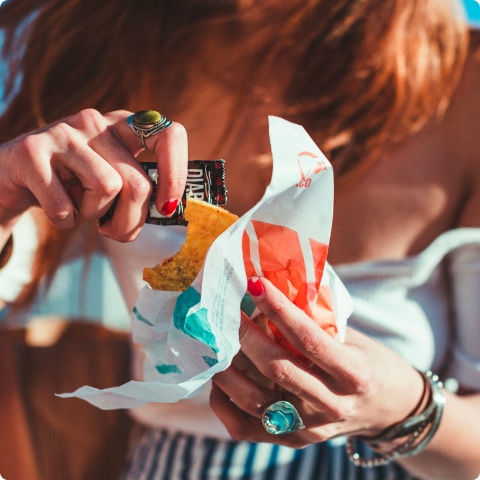
We use paper wraps and bags for tacos, burritos, chalupas, crunchwraps, desserts and chips which may be recyclable depending on where you live
NextGen Cup Consortium
We are a partner in the NextGen Consortium, managed by the Center for the Circular Economy at Closed Loop Partners, making strides to increase recycling access and circular pathways for foodservice packaging.
RESTAURANT RECYCLING
We are providing a means to which consumers have access to recycling by adding recycling and/or composting bins to restaurants, where infrastructure permits.
Our Energy Practices
As we continue to grow, we are always looking for new and exciting opportunities within our restaurants, incorporating where possible green building standards to reduce energy consumption, water use, greenhouse gas emissions, and waste.
Renewable Energy
Renewable Energy Study
We are constantly innovating to find solutions to reduce our energy consumption at restaurants. We have implemented and are exploring a variety of energy reduction initiatives, including utilizing solar panels in some restaurants
Electric Vehicle Charging
Several restaurants have electric vehicle charging stations, and we are exploring adding stations to more restaurants in the future.
LED Lights
The majority of Taco Bell restaurants utilize LED lights, which have a longer lifespan and contribute to a lower carbon footprint. All new restaurants are built with LED light

